Letting AI read your purchase invoices while you keep the final say
· By Bee Flow · 6 min read
Belgium has confirmed that its tolerance period for mandatory e-invoicing is over. In the Netherlands invoices still arrive as PDFs. What AI can take off your hands, which invoices always go past a person, and how to test it without booking anything.

On 7 April 2026 the Belgian government announced on efactuur.belgium.be (in Dutch) that the general tolerance period for e-invoicing is over. Since 1 January 2026, Belgian VAT-registered businesses must exchange structured electronic invoices with each other, and the leniency of the first three months has now ended. Only self-billing keeps a targeted, temporary tolerance, until 30 June 2026.
In the Netherlands nothing has been settled yet. In a letter to parliament of 10 March 2026 (in Dutch), the state secretary for Finance writes that the consultancy EY advises broad e-invoicing, domestic transactions included. The cabinet is still weighing that advice and expects to give more clarity "this summer". What is fixed is the European agreement in the VAT in the Digital Age (ViDA) package: from 1 July 2030, businesses must report their cross-border B2B trade within the EU digitally, per transaction, using electronic invoices that follow an EU standard.
For a Dutch office this means that purchase invoices will keep arriving as PDFs for a few more years, attached to an e-mail or downloaded from a supplier portal. Someone opens each one, retypes the amount, the date and the invoice number, looks up the matching order and picks a ledger account. AI can prepare most of that work. The question is where you draw the line.
What AI does well with a purchase invoice
A language model reads a PDF much the way a person does. It finds the supplier's name, the invoice number, the invoice date, the due date, the amounts before and after VAT, the VAT rate and the IBAN to pay to. It does so even when every supplier uses a different layout, and that retyping is exactly what takes the time now.
After that it can propose two things. It looks up the order that belongs to the order number or description and says whether the amounts agree. And it suggests a ledger account, based on what was booked for this supplier before. That second part is a suggestion, not a decision. A model that has seen "office supplies" a hundred times will pick that account the hundred-and-first time as well, even when this time it was a laptop that belongs on the balance sheet as an asset.
Have the model answer in fixed fields rather than in running text. Then you can check every field and compare it with what you would have filled in yourself.
Where a person has to keep deciding
Reading and proposing is work you can hand off. Spending money is not. Decide up front which invoices always go past a person before they are booked or paid. A few rules that work in practice:
- No invoice is booked without a person's approval. The AI prepares the entry, someone presses approve.
- Above an amount you choose, a second person looks as well. In a small office that is often the owner.
- A supplier you have not dealt with before always goes to a person. A first invoice from an unknown party is a good moment to call, or to check that something was really ordered.
- A different IBAN from the one you used for that supplier before stops the invoice. A changed account number on an invoice that otherwise looks normal is a well-known form of fraud. Check such a change through a phone number you already had, not the one printed on the invoice.
- No matching order found, or an amount that differs from the order: to a person.
The model does not have to come up with these rules itself. You set them as fixed checks that run after the reading. Then whether an invoice of 8,000 euros goes straight through does not depend on how a model happens to answer that day.
An example: Kantoor Voorbeeld
Kantoor Voorbeeld is made up. It is an installation company with fourteen people that receives about 250 purchase invoices a month in one shared mailbox. Margriet, the office manager, now spends two mornings a week on them.
In the new set-up, AI reads each invoice as it arrives and puts the fields in an overview, with a suggested order and ledger account. Invoices under 500 euros from known suppliers with a matching order get a green tick: Margriet goes through that list once a day and approves it in a few minutes. Everything above that amount, every new supplier and every changed IBAN reaches her separately, with the reason attached. Above 5,000 euros the owner approves too. The booking itself still happens in the accounting package they already had.
The numbers in this example were chosen to show how it works. Which limits fit your office depends on your amounts and on who is authorised to sign.
Testing without booking anything
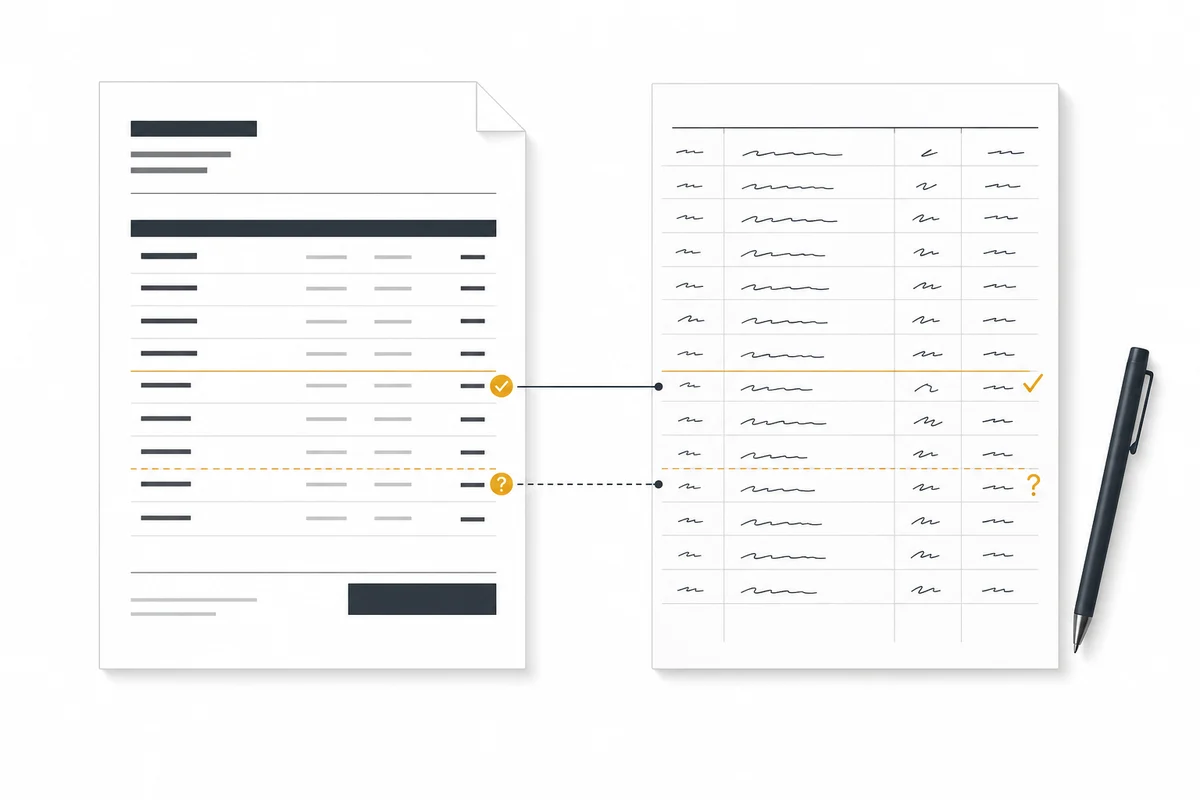
Do not start by booking. Start by watching. A set-up that works well is a shadow period of two or three weeks:
- The AI reads every incoming invoice and writes its proposal to a separate overview. Nothing is booked and nothing is paid.
- During those weeks you book the old way, by hand.
- At the end you put the two side by side. How often were the amount, the invoice number, the order and the ledger account right?
Pay most attention to the awkward cases, because that is where the mistakes are: credit notes, invoices with reverse-charge VAT, foreign suppliers, invoices of several pages, a scanned invoice that is slightly crooked. Look them up in your archive and run them through on purpose. Test your rules as well: send in a copy of an invoice in which you changed the IBAN, and see whether it really gets stopped.
Only when the figures convince you do you move to proposals that someone approves. Even then, keep the amount limit lower at first than where you eventually want it.
And when the e-invoice does arrive
A structured e-invoice already carries the fields in a fixed format. The reading gets smaller, which is good news. The decisions in this piece stay: which order does it belong to, which ledger account, may this be paid, does this account number really belong to the supplier. If you settle now who approves what, you will not have to work it out again in 2030.
This article is not legal or tax advice. Ask your accountant or adviser which rules apply to your business.
How to set this up with Bee Flow
In Bee Flow you can build this flow as an automation, or have us set it up as AI automation as a service. The same approach works for automating quote requests from your inbox. AI reads the purchase invoice and fills in fixed fields, your own rules decide which invoices must go past a person, and an invoice with an open question waits for an approval before anything happens. You choose which model does the reading, for example a European provider, and Bee Flow can run on your own server so the invoices stay in house: see self-host or EU cloud. Having a colleague approve a step is not in every licence, see the plans. If you want to see what this looks like for your own invoices, get in touch.